Search This Blog

2014-05-27

CAF French Wing Newsletter: Mai 2014 / May 2014

Forwarded message - From: CAF French Wing


Visualiser cet email avec votre navigateur / View this email in your browser
Chers amis,
Merci pour l'intérêt que vous portez à notre association. Voici la newsletter "publique" de mai 2014.
 

Nous espérons que cette newsletter vous plaira, voire vous donnera l'envie de nous rejoindre. N'hésitez pas à la diffuser autour de vous!

Cordialement,

Bertrand Brown
Vice-président (Executive Officer) CAF French Wing
 
Dear friends,

Thank you for your interest in our unit. Here is the "public" edition of our monthly newsletter, Airshow.

We hope that you will enjoy this newsletter, and that it will make you want to join the French Wing!

Feel free to share this newsletter with friends and relatives you believe might be interested.

Best regards,

Bertrand Brown
CAF French Wing Executive Officer


Copyright © 2014 CAF French Wing, Tous droits réservés.

Notre adresse de contact est / Our mailing address is:
CAF French Wing
9 rue de la Chapelle
Saint Ange le Vieil 77710
France


GAR D-Day 70 – Pt.10 – Dakotas over Normandy Preview, 04-08/06/14


Huw Hopkins posted: "From 5 to 8 June the skies over the Cotentin Peninsular will once again be filled with the sight and sound of Douglas DC-3 Dakotas as the Round Canopy Parachute Team (RCPT) presents Dakotas over Normandy, an event that will bring together up to 10 of the "

New post on GAR

D-Day 70 – Pt.10 – Dakotas over Normandy Preview, 04-08/06/14

by Huw Hopkins
From 5 to 8 June the skies over the Cotentin Peninsular will once again be filled with the sight and sound of Douglas DC-3 Dakotas as the Round Canopy Parachute Team (RCPT) presents Dakotas over Normandy, an event that will bring together up to 10 of the classic Douglas type. Huw Hopkins previews this historic event.


Aerobuzz : Long-range strike bomber & Nuit blanche au musée du Bourget

Bugatti 100p débuts

Thx Jean-Luc

Forwarded message - From: <ailesetplumes@aol.com>

The Bugatti 100P has been on our radar since February, with its maiden voyage set to take place at some point later this year. Until then, the aeronautic wonder sits at the Mullin Automotive Museum in Southern California, where it made its first debut in the Mullin museum's “Art of Bugatti” exhibition.
The clone, built by Scott Wilson, John Lawson and Simon Birney of Le Reve Bleu in 2009, was the first re-creation of Ettore Bugatti's flying masterpiece. It is set to leave the Mullin July 12 and is headed back to Le Reve Bleu so it can be prepped for take-off.


Read more: http://www.autoweek.com/article/20140513/carnews/140519931#ixzz32tbU18QW


Comics [vintage-and-warbirds] Milton Caniff & The Art of War

Forwarded message - From: Steve Link steven_


Pretty good article….


By Rachel Morris
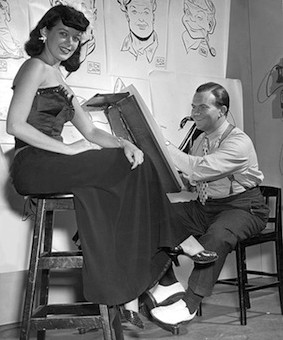
Milton Caniff never served in the military, but, his spirit was on virtually every battlefield of WW II. His artwork on the nose of fighters and bombers and in thousands of military papers touched those in combat in ways nothing else could.     Born in 1907, Caniff moved from Ohio to New York in 1932 to pursue his career as a cartoonist. Two years later he found fame with adventure strip Terry and the Pirates, published daily by the Chicago Tribune New York News Syndicate. When WW II broke out, Caniff was deemed medically unfit for military service. Instead, the fiercely patriotic cartoonist used his artwork to raise the morale of U.S. troops, with his pen becoming a popular weapon in the Allied arsenal. The Syndicate owned all rights to Terry and the Pirates, so Caniff began producing a free version of the strip for military newspapers. First appearing in October 1942, within months it developed into a standalone story titled Male Call, featuring a cast of new characters. Thanks to the allure of voluptuous femme fatale Miss Lace, Male Call quickly became an enduring favorite. Lace was a natural progression from the Burma character in Terry and the Pirates, but where Burma was blonde with a hint of vice, Lace was brunette and, according to Caniff, "Innocent … but sexy as hell."


Got some photographs you would like included in the Vintage and Warbird web site?  Post them on the Vintage and Warbirds Pictures list or send them direct to the Webmaster at darrylgibbs@yahoo.com

Aircraft of Australia Aviation Photography:
http://www.aircraftofaustralia.com

Vintage and Warbirds of the world http://www.vintageandwarbirds.com
H

GAR Airshow Review – Planes of Fame Airshow 2014 Practice Day


Kieran Lear posted: "The first weekend of May saw the annual Planes of Fame Airshow at Chino Airport, California, take place. Often described as one of the best airshows in the country, it was an event GAR Deputy Editor, Elliott Marsh, and GAR writer, Kieran Lear, couldn't af"

New post on GAR

Airshow Review – Planes of Fame Airshow 2014 Practice Day

by Kieran Lear
The first weekend of May saw the annual Planes of Fame airshow at Chino Airport, California, take place. Often described as one of the best airshows in the country, it was an opportunity GAR Deputy Editor, Elliott Marsh, and GAR writer, Kieran Lear, couldn't afford to miss. Kieran reports from the days leading up to this illustrious airshow, with photographs as credited.


Kieran Lear | May 14, 2014 at 7:30 pm | Tags:  URL: http://www.globalaviationresource.com/v2/F5qry


Air Journal : Le 16 mai 1936 dans le ciel : L’hôtesse de l’air Daphne Kearley assure son premier service

Posted: 15 May 2014 03:03 PM PDT
Histoire de l'aviation - 16 mai 1936. Le 15 mai 1930, la compagnie aérienne américaine Boeing Air Transport, l'ancêtre d'United Air Lines, révolutionne le transport aérien en accueillant pour la première fois …
Le 16 mai 1936 dans le ciel : L'hôtesse de l'air Daphne Kearley assure son premier service


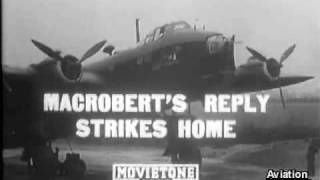
Video: "Short Stirling Bomber (better quality footage)"


The Stirling was the first four-engined British heavy bomber of the Second World War. Built by Short Brothers, it was to have a relatively short operational career.

Throughout the 1930s, the Royal Air Force was interested primarily in twin-engine bombers and invested heavily in development of huge engines in the 2,000 horsepower (1,500 kW) class in order to improve performance. In the U.S. and USSR were developing bombers with four smaller engines, which proved to have excellent range and fair lifting capacity, so in 1936 the RAF also decided to investigate the feasibility of the four-engined bomber.

The Air Ministry Specification B.12/36 had a mixture of requirements.[citation needed] In addition to a 14,000 lb (6,350 kg) bombload carried to a range of 3,000 miles (4,800 km) (incredibly demanding for the era), the aircraft should also be able to be used as a troop transport for 24 soldiers. The idea was that it would fly troops to far corners of the British Empire and then support them with bombing. To help with this task as well as ease production, it needed to be able to be broken down into parts for transport by train. Since it could be operating from limited "back country" airfields, it needed to lift off from a 500 ft (150 m) runway and able to clear 50 ft (15 m) trees at the end, a specification most small aircraft would have a problem with today. The wingspan was limited to 100 ft (30 m) so the aircraft would fit into existing hangars. The wingspan limit was also imposed in an unsuccessful attempt to ensure the Stirling's weight was kept down.

Operational status wasn't reached until January 1941 by No. 7 Squadron RAF. The first three Stirlings flew a mission on 10 February 1941 over fuel storage tanks in Rotterdam, and from spring of 1942 it started to be used in greater numbers. From May 1943, air raids on Germany started with over a hundred Stirlings at once.

Despite the "disappointing performance" at maximum altitude, Stirling pilots were delighted to discover that, due to the thick wing, they could out-turn the Ju 88 and Me 110 nightfighters they faced. Its handling was much better than that of the Halifax and some preferred it to the Lancaster. Based on its flight characteristics, Pilot Murray Peden of No. 214 RAF Squadron flatly described the Stirling as "one of the finest aircraft ever built."

Another consequence of the thick wing however was a low ceiling and many missions were flown as low as 12,000 ft (4,000 m). This was a disadvantage on many raids, notably if crews were attacking Italy and had to fly through (rather than "over") the Alps. When Stirlings were on combined operations with other RAF bombers which could fly at higher altitudes, the Luftwaffe concentrated on the low-flying Stirlings. Within five months of being introduced, 67 out of the 84 aircraft delivered had been lost to enemy action or written off after crashes.

The Stirling's huge maximum bomb load was only able to be carried for relatively short distances of around 590 miles. On typical missions deep into Germany or Italy a smaller 3,500 lb (1,590 kg) load was carried, consisting of seven 500 lb (227 kg) bombs. This was the sort of load being carried by the RAF's medium bombers such as the Vickers Wellington and, by 1944, by the de Havilland Mosquito. Perhaps the biggest problem with the design was that the bomb bay had two structural dividers running down the middle, limiting it to carrying nothing larger than the 2,000 lb (907 kg) bomb. As the RAF started using the 4000 lb (1,815 kg) "cookies" and even larger "specials," the Stirling became less useful. In 1943, it was decided to withdraw Stirlings to secondary tasks.


By December 1943, Stirlings were being withdrawn from frontline service as a bomber, increasingly being used for deploying mines outside German ports, electronic countermeasures and dropping spies deep behind enemy lines at night (through the now unused ventral turret ring).

General characteristics
Crew: 7
Length: 87 ft 3 in (26.6 m)
Wingspan: 99 ft 1 in (30.2 m)
Height: 28 ft 10 in (8.8 m)
Wing area: 1,322 ft² (122.8 m²)
Empty weight: 44,000 lb (19,950 kg)
Loaded weight: 59,400 lb (26,940 kg)
Max takeoff weight: 70,000 lb (31,750 kg)
Powerplant: 4× Bristol Hercules II radial engines, 1,375 hp (1,030 kW) each
Performance
Maximum speed: 255 mph (410 km/h) at 21,000 ft (6,400 m)
Range: 2,330 mi (3,750 km)
Service ceiling: 16,500 ft (5,030 m)
Rate of climb: 800 ft/min (4 m/s)
Wing loading: 44.9 lb/ft² (219.4 kg/m²)
Power/mass: 0.093 hp/lb (0.153 kW/kg)
Armament
8 x 0.303 in (7.7 mm) Browning machine guns: 2 in the nose, 4 in the tail, 2 dorsal
Up to 18,000 lb (8,164 kg) of bombs


©2014 YouTube, LLC 901 Cherry Ave, San Bruno, CA 94066

2014-05-26

Two new aircraft types for the Belgian Air Force presented

Two new Belgian Air Force aircraft types, the Airbus Helicopters NH90 NFH and the Airbus A321, were officially presented last week. Have a look at a new special feature on the Belgian Wings website by clicking the pic.

http://www.belgian-wings.be/Webpages/Navigator/News/Special%20Features/Two%20new%20aircraft%20types%20for%20the%20Belgian%20Air%20Force/Twe%20new%20BAF%20aircraft%20types%20frontpage.html 


Best regards,

Daniel Brackx
www.belgian-wings.be


Next-generation helicopter EC175 preparing the entry-into-service @ NHV


May 26th, will be the start of the Airbus Helicopters EC175 Maturity Campaign at NHV (Noordzee Helikopters Vlaanderen) in Ostend, Belgium. During a two week period several flights will be conducted to further prepare ourselves as part of this new generation aircraft’s entry into service. The Maturity campaign follows a demo tour conducted in the North Sea.

The purpose of this maturity campaign is to test both support and operational actions in a customer oriented environment. For this reason we have invited several of our partners during the first week of the campaign to join us in these demo flights and experience the comfort and capabilities of the EC175. During the second week of the campaign Airbus Helicopters will put more focus on testing and developing its support and services. During this period the aircraft will fly at least 5 hours a day! 


Since 2012, NHV ordered 16 EC175’s which will increase our fast growing fleet from 28 to 44 helicopters. The EC175 was developed to meet the increasing needs of the oil and gas industry. This new generation rotorcraft offers outstanding performances with unmatched cost efficiency. The investment of more than €200 million is part of our strategy of owning and operating a young and modern fleet with the highest safety standards. Aside from transportation service for the Oil and Gas industry, the EC175 will also be offered for our Search and Rescue activities. The first delivery of the EC175 will happen later this year.

www.nhv.be

www.belgian-wings.be